
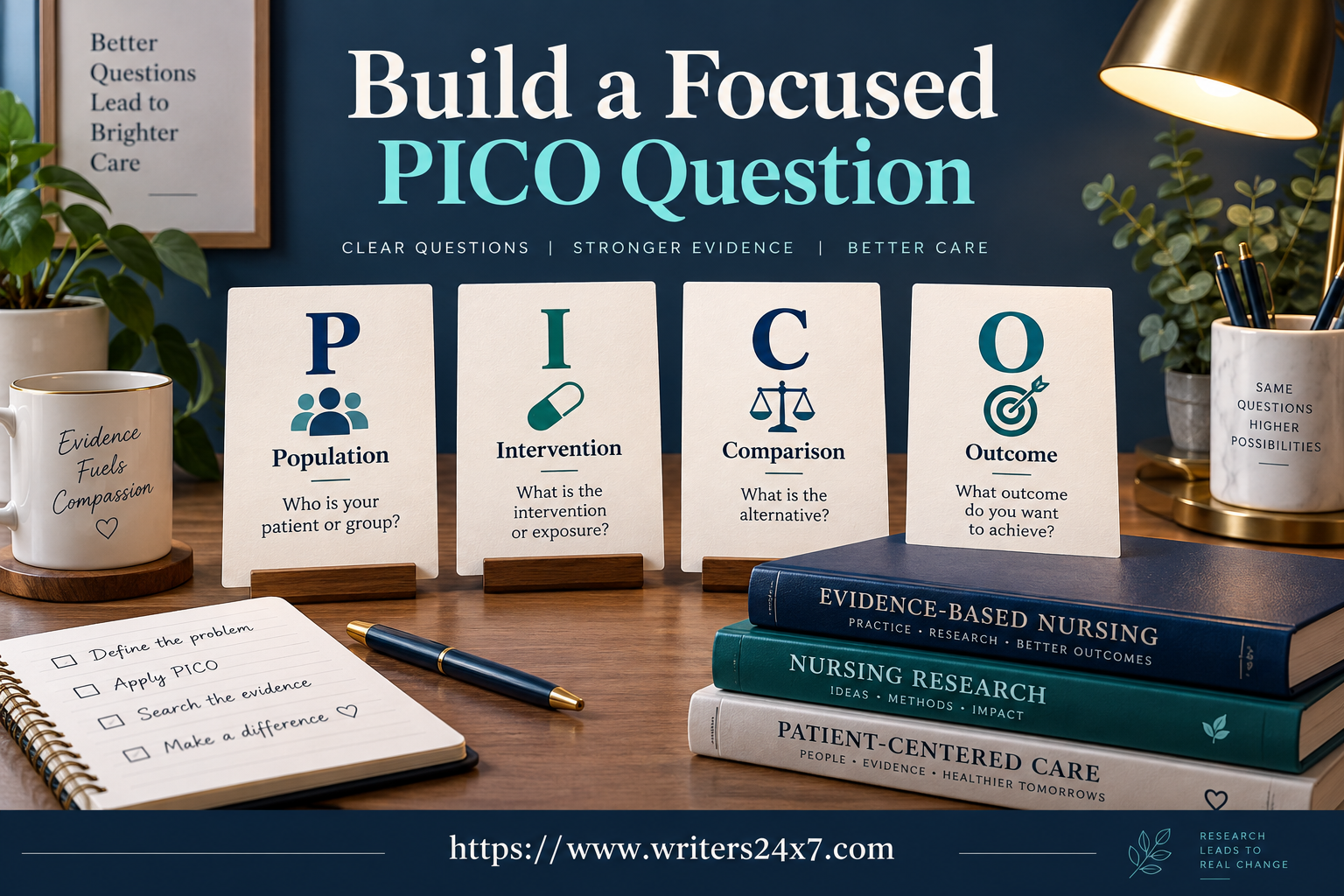
A PICO question turns a broad area of interest into a focused question that can guide a search for evidence. The letters commonly represent population or problem, intervention, comparison, and outcome. For nursing students, the framework can make an evidence-based practice assignment more manageable by clarifying exactly what the paper is trying to investigate.
The framework is most useful when its components fit the kind of question being asked. It is not a requirement to force every nursing topic into an intervention comparison. Questions about experiences, meanings, or implementation may need a different framework, depending on the assignment and research approach.
Get Your Custom Essay Written From Scratch PICO Question: 13 Easy Steps for Nursing Students
 Get Answer Over WhatsApp
 Order Paper Now
Just from $13/Page
This guide explains how to construct and refine a PICO question for coursework. Its examples concern nursing education and are hypothetical research questions, not claims that one teaching approach works better than another. Use your course guidance and librarian’s support when translating the question into a formal search strategy.
1. Start with the assignment, not the acronym
Read the brief to identify the expected product. You may be asked to formulate a PICO question, search for studies, appraise evidence, or propose a project. Each task requires a different level of detail, even when all of them begin with PICO.
Record any restrictions on topic, population, study design, publication date, and number of sources. Check whether the course uses PICO or PICOT, where the additional component commonly specifies time. Follow the meaning assigned in your own course materials rather than assuming every instructor uses identical terminology.
Also identify what the assignment does not require. A classroom evidence review does not automatically authorize a student to introduce a clinical intervention or collect patient data. Keep the writing task and any real-world project approvals separate. A well-framed question is a research planning tool, not permission to change practice.
2. Choose a problem that can be investigated
Begin with an area you genuinely want to understand. In nursing education, you might be interested in how students prepare for a communication simulation. That is a useful starting point, but it remains too broad for a focused comparison.
Ask what uncertainty lies inside the topic. Are you interested in knowledge, observed performance, confidence, or retention? These are different outcomes. Choosing one primary uncertainty gives the PICO question a clearer direction and helps you decide which studies are relevant.
Avoid choosing a topic solely because it sounds impressive. A manageable question supported by accessible evidence usually produces a stronger assignment than a highly specialized question you cannot investigate within the available time. Initial reading can help you judge whether the scope is realistic before you commit to it.
3. Define the population or problem
The population identifies whom the PICO question concerns. It should be specific enough to make the evidence meaningful without adding restrictions that serve no analytical purpose. Relevant characteristics might include educational stage, setting, or a clearly defined problem.
For a teaching example, first-year nursing students preparing for a communication simulation is more focused than all healthcare students. However, adding a specific campus, semester, and age range may make the PICO question unnecessarily narrow unless those details are important to the assignment.
Write down why each boundary matters. If you cannot explain why a characteristic changes the PICO question, consider removing it. A defensible population definition helps you avoid accepting a study from a substantially different group without discussing whether its findings are applicable.
4. Specify the intervention clearly
The intervention is the approach, activity, or exposure being examined in an intervention-focused question. Describe it in terms that a reader could recognize in a study. A vague phrase such as better teaching does not identify a searchable intervention.
In the nursing education example, the intervention might be a structured peer-rehearsal activity before a simulation. You would need to understand what structured means in the studies you later include. Duration, facilitation, feedback, and task design may vary, so avoid assuming that all activities with the same label are equivalent.
Keep the intervention description proportionate to the PICO question. You do not need to write a full protocol at this stage, but you do need enough clarity to distinguish the approach from its comparison. If the description keeps expanding, the topic may contain several interventions that should be considered separately.
5. Choose a meaningful comparison
The comparison tells the reader what the intervention is being considered against. It could be a usual educational approach, an alternative activity, or no additional activity, depending on the research question. The comparison should be explicit enough to support a fair interpretation.
For example, structured peer rehearsal could be compared with individual preparation using the same learning materials. That creates a more interpretable contrast than comparing rehearsal with an undefined standard approach. Later, when reading studies, check what the comparison group actually received.
Do not invent a comparison merely to fill the letter C. If the real question concerns how students experience a learning activity, an intervention-comparison structure may be inappropriate. Discuss an alternative framework with your lecturer when the PICO question’s purpose does not fit PICO naturally.
6. Select an outcome you can recognize
An outcome states what difference or result the PICO question examines. Choose a primary outcome that aligns with the uncertainty you identified. In the example, observed communication performance is different from self-reported confidence, satisfaction, or knowledge.
Think about how the outcome might be measured without prescribing a particular instrument prematurely. A study could use an assessor-rated performance rubric, but you would need to inspect the rubric’s content and scoring to understand what the result means. Similar labels do not guarantee equivalent measures.
Avoid vague outcomes such as better results or improved care in an educational assignment unless you define them carefully. An outcome should tell you what evidence would answer the PICO question. If you cannot imagine what a relevant result would look like, refine the outcome before beginning the main search.
7. Add time when it changes the question
Some assignments use PICOT to include a timeframe. Time can refer to when the outcome is assessed or the duration over which a change is examined. Follow your course’s definition and explain the role of time in your particular question.
For an educational example, immediate simulation performance and performance several weeks later address different questions. The first concerns a near-term result; the second may concern retention or transfer. Choosing a timeframe can therefore change which studies belong in the review.
Do not add an arbitrary number of weeks just to complete a template. Use a timeframe that follows from the learning issue, the assignment, or the available evidence. If the evidence uses varied follow-up periods, explain that variation during appraisal rather than quietly treating the outcomes as identical.
8. Assemble the question in plain language
A working question might be: Among first-year nursing students, how does structured peer rehearsal, compared with individual preparation, affect observed communication performance in a simulation? This identifies a population, intervention, comparison, and outcome without asserting the answer.
Read the PICO question aloud. Can a classmate identify each component? Does the wording imply that the intervention must be beneficial? Replace leading language such as how much does this improve with neutral language when the evidence has not yet been reviewed.
Then write a one-sentence explanation of why the PICO question matters. The rationale should connect to a genuine educational uncertainty. Avoid broad claims about patient outcomes when the proposed evidence concerns only student performance in a classroom simulation. Keep the significance aligned with what the question can actually establish.
9. Translate the PICO question into search concepts
Create a table of main concepts and alternative terms. For the example, population terms might include nursing students and student nurses. Intervention terms might include peer rehearsal, peer practice, or peer learning, although you will need to inspect whether the retrieved studies describe the intended activity.
Use database subject headings and keywords as appropriate. Search syntax differs between platforms, so consult the relevant help pages or a librarian. Record the database, date, terms, and filters used. A transparent search log makes revision easier and supports a clear methods description when required.
You do not always need every PICO component in the first search. Adding too many concepts can exclude relevant studies whose titles or indexing use different language. Start with the most distinctive concepts, inspect the results, and refine deliberately. Explain your choices if the assignment requires a reproducible search strategy.
10. Test whether the question is too broad or narrow
Run a small exploratory search before committing to the final wording. If results cover many unrelated interventions and outcomes, the PICO question may need a clearer population, setting, or primary outcome. If almost nothing relevant appears, check terminology and database choice before concluding that no evidence exists.
Broaden one element at a time when necessary. You might remove an unnecessary year-of-study restriction while retaining the intervention and outcome. Record the reason so that the final scope does not appear arbitrary.
Avoid changing the PICO question merely to obtain a preferred answer. Refinement should improve feasibility and conceptual clarity, not exclude inconvenient findings. If the available evidence remains limited, that limitation can become part of the assignment’s conclusion rather than a reason to invent studies or overstate weak evidence.
11. Match evidence to the type of question
Study design matters because different designs answer different questions. An intervention comparison calls for evidence that can address the comparison, while an exploration of experience may rely on qualitative approaches. Do not judge every study by one universal checklist regardless of its purpose.
The University of Minnesota’s evidence appraisal guidance emphasizes checking the PICO question, methods, and applicability of findings. Use the appraisal tool specified by your course and consider the actual quality of each study, not only its design label.
When a source only partly matches your PICO question, state the mismatch. A study of experienced professionals may provide context for a student-focused question, but it does not automatically answer it. Clear distinctions between direct and indirect evidence make the eventual synthesis more useful.
12. Common PICO mistakes
One mistake is including several unrelated outcomes. A PICO question that asks about confidence, knowledge, grades, communication, and long-term practice can become too broad to answer well. Select a primary outcome and explain any secondary outcomes only if the assignment allows them.
Another mistake is using a comparison that remains undefined. Terms such as usual care or standard teaching require examination in each study. Different settings may use those labels for different activities, which affects how confidently you can compare findings.
A third mistake is presenting the PICO question as proof. PICO organizes an inquiry; it does not establish that an intervention is effective. Keep the wording neutral and let the evidence determine the conclusion. If results are mixed or uncertain, report that honestly.
13. Build the assignment around the question
Use the introduction to explain the problem and present the final PICO question. The search section should show how the question became a strategy. The evidence section should compare relevant studies, and the discussion should explain what they collectively suggest and what remains uncertain.
Return to the exact question in the conclusion. If the review cannot answer it fully, identify why: limited studies, indirect populations, inconsistent measures, or methodological weaknesses. A qualified answer is stronger than a confident statement unsupported by the evidence.
Keep the PICO question visible while drafting. When a paragraph seems unrelated to one of its components or to the rationale, ask whether it belongs. This simple check helps prevent an evidence-based practice assignment from expanding into a general essay about the whole subject.
A PICO question worksheet you can complete before searching
Use a separate planning page to test the relationship between your question and the evidence you intend to find. Write the current PICO question at the top and date the page. Under it, record the assignment requirement, the uncertainty you want to investigate, and the boundaries you can justify. This gives you a record of your reasoning when the wording changes during preliminary reading.
For the fictional communication-training example, begin with the population. Record first-year nursing students, then explain why their educational stage matters. If your interest concerns early learning, this boundary has a purpose. If your interest concerns a skill taught throughout the course, restricting the population to first-year students may unnecessarily exclude useful evidence. The worksheet should explain the decision rather than simply repeat the population label.
Next, define the intervention and comparison in separate cells. Describe structured peer rehearsal in terms that help you recognize it in a study, and record individual preparation as the proposed comparison. Add a note asking whether both groups received the same underlying materials. That detail matters because a difference in materials could complicate interpretation of any observed difference between the groups. A PICO question identifies a comparison; appraisal investigates whether the comparison was informative.
For the outcome, record observed communication performance and explain what would count as relevant evidence. An assessment rubric may address this outcome, whereas a satisfaction questionnaire addresses a different question. You can retain a satisfaction study as contextual evidence if the assignment permits, but label that use clearly. Do not quietly change the outcome in your PICO question merely because satisfaction studies are easier to find.
Add a search-decision column to the worksheet. Record likely synonyms, database subject headings that you have actually checked, and restrictions you plan to test. Leave room for discoveries during the first search. If a term retrieves mostly unrelated material, note the problem and the adjustment. Your goal is a transparent explanation of how the PICO question became a search, not a perfect-looking search history reconstructed after the assignment is finished.
Finally, ask another student or a librarian to read the worksheet without your verbal explanation. Can they identify the population, intervention, comparison, and outcome? Can they explain why a sample source would be included or excluded? If two readers interpret a key term differently, revise its definition. This feedback tests the clarity of the PICO question before you invest time in a full evidence review.
Keep the worksheet beside the draft and revisit it at each major transition: after initial searching, before selecting the final evidence, and before writing the conclusion. Record only meaningful changes. A brief note about the reason for a revised population or outcome is more useful than saving many nearly identical versions without explanation. The finished assignment should reflect the final scope consistently across its introduction, search account, analysis, and conclusion.
Frequently asked questions
Must every question use PICO?
No. PICO is useful for many focused intervention questions, but other question types may fit other frameworks. Use the framework required by your course or discuss alternatives when the structure does not match the inquiry. The research purpose should guide the format.
Can I revise the question after searching?
Yes, especially during exploratory work. Record the change and explain why it improves clarity or feasibility. Avoid quietly changing the scope after seeing results in order to favor a particular conclusion. Formal reviews may require additional procedures for documenting amendments.
What if I find very little evidence?
Check synonyms, subject headings, databases, and unnecessary restrictions. Ask a librarian for help. If the evidence remains limited, describe that limitation and avoid treating absence of located evidence as proof that an intervention has no effect.
Take the next step
Draft your question, label its components, and test it with a small search. Revise the wording until the population, intervention, comparison, and outcome are clear enough to guide selection. Then move into careful appraisal and synthesis.
Explore the NurseHomeworks blog for related nursing study topics, Writers24x7 for academic writing resources, and DissertationFlow for a supplied research-writing resource. Keep the final question, evidence judgments, and assignment consistent with your institution’s requirements.
Needs help with nursing assignment?
We are available 24x7 to deliver the best services and assignment ready within 3-4 hours? Order a custom-written, plagiarism-free paper
Get Answer Over WhatsApp
Order Paper Now