
nursing dosage calculation practice can feel difficult because nursing assignments test more than memory. They test whether you can notice important information, connect evidence to a patient or problem, explain priorities, and communicate a safe conclusion. This 2026 guide turns that work into a clear, repeatable process.
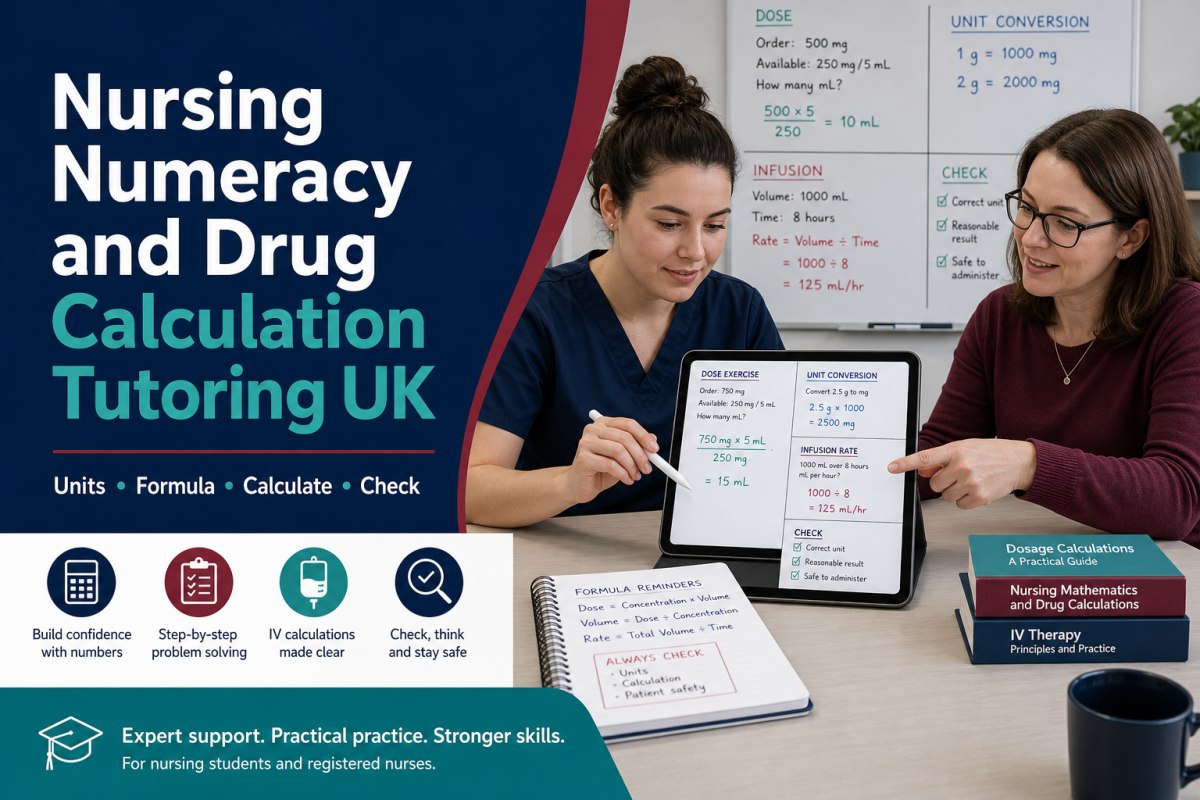
nursing dosage calculation practice is most useful when it becomes a repeatable reasoning process. For student nurses preparing for exams and medication administration, the central challenge is calculating an ordered dose accurately while also checking units, reasonableness, patient factors, and medication safety. A strong approach does more than produce a correct-looking final answer. It makes the evidence, assumptions, priorities, and checks visible. That visibility helps an instructor assess learning and helps the student identify exactly where reasoning needs improvement.
Get Your Custom Essay Written From Scratch Nursing Dosage Calculation Practice: 12 Safe Steps to Master
 Get Answer Over WhatsApp
 Order Paper Now
Just from $13/Page
The practical goal is to use one consistent dimensional-analysis workflow and a separate clinical safety check for every calculation. Keep the assignment instructions beside you throughout the process. Requirements differ across schools, courses, jurisdictions, and clinical settings, so a general guide must never replace the rubric, current course materials, an instructor’s directions, or local clinical policy.
Educational note: This article supports learning and assignment planning. It is not patient-specific medical advice and must not replace faculty supervision, current clinical guidance, medication references, or organizational policy.
Table of Contents
- Why this topic matters
- Core concepts
- Step-by-step method
- Worked example
- How to strengthen the assignment
- Research and source strategy
- Critical thinking and patient safety
- Common mistakes
- Editing checklist
- Frequently asked questions
Why nursing dosage calculation practice Matters
Nursing education is increasingly organized around competency, clinical judgment, safety, evidence, communication, and reflection. A polished paper matters, but the reasoning underneath it matters more. Faculty members usually award marks for how well a student interprets information, applies an appropriate framework, supports decisions, acknowledges uncertainty, and evaluates outcomes.
nursing dosage calculation practice is most useful when it becomes a repeatable reasoning process. For student nurses preparing for exams and medication administration, the central challenge is calculating an ordered dose accurately while also checking units, reasonableness, patient factors, and medication safety. A strong approach does more than produce a correct-looking final answer. It makes the evidence, assumptions, priorities, and checks visible. That visibility helps an instructor assess learning and helps the student identify exactly where reasoning needs improvement.
The practical goal is to use one consistent dimensional-analysis workflow and a separate clinical safety check for every calculation. Keep the assignment instructions beside you throughout the process. Requirements differ across schools, courses, jurisdictions, and clinical settings, so a general guide must never replace the rubric, current course materials, an instructor’s directions, or local clinical policy.
A useful first move is to translate the rubric into actions. Highlight the command words—such as analyze, prioritize, compare, justify, calculate, or evaluate—and identify the evidence required for each. Then allocate words according to the marks. A criterion worth 35 percent deserves substantially more development than one worth 5 percent.
Core Concepts You Need to Understand
1. Ordered dose and available dose
This concept is part of the reasoning chain, not an isolated definition to memorize. Explain what ordered dose and available dose means in the context of the task, show the data or evidence that makes it relevant, and state how it affects the next decision. When evidence is incomplete, name the uncertainty and identify what additional assessment, source, calculation, or clarification would reduce it.
2. Unit conversion
This concept is part of the reasoning chain, not an isolated definition to memorize. Explain what unit conversion means in the context of the task, show the data or evidence that makes it relevant, and state how it affects the next decision. When evidence is incomplete, name the uncertainty and identify what additional assessment, source, calculation, or clarification would reduce it.
3. Dimensional analysis
This concept is part of the reasoning chain, not an isolated definition to memorize. Explain what dimensional analysis means in the context of the task, show the data or evidence that makes it relevant, and state how it affects the next decision. When evidence is incomplete, name the uncertainty and identify what additional assessment, source, calculation, or clarification would reduce it.
4. Tablets and liquids
This concept is part of the reasoning chain, not an isolated definition to memorize. Explain what tablets and liquids means in the context of the task, show the data or evidence that makes it relevant, and state how it affects the next decision. When evidence is incomplete, name the uncertainty and identify what additional assessment, source, calculation, or clarification would reduce it.
5. Weight-based dosing
This concept is part of the reasoning chain, not an isolated definition to memorize. Explain what weight-based dosing means in the context of the task, show the data or evidence that makes it relevant, and state how it affects the next decision. When evidence is incomplete, name the uncertainty and identify what additional assessment, source, calculation, or clarification would reduce it.
6. Safe-dose ranges
This concept is part of the reasoning chain, not an isolated definition to memorize. Explain what safe-dose ranges means in the context of the task, show the data or evidence that makes it relevant, and state how it affects the next decision. When evidence is incomplete, name the uncertainty and identify what additional assessment, source, calculation, or clarification would reduce it.
7. IV flow and pump rates
This concept is part of the reasoning chain, not an isolated definition to memorize. Explain what IV flow and pump rates means in the context of the task, show the data or evidence that makes it relevant, and state how it affects the next decision. When evidence is incomplete, name the uncertainty and identify what additional assessment, source, calculation, or clarification would reduce it.
8. Rounding rules
This concept is part of the reasoning chain, not an isolated definition to memorize. Explain what rounding rules means in the context of the task, show the data or evidence that makes it relevant, and state how it affects the next decision. When evidence is incomplete, name the uncertainty and identify what additional assessment, source, calculation, or clarification would reduce it.
9. Independent double checks
This concept is part of the reasoning chain, not an isolated definition to memorize. Explain what independent double checks means in the context of the task, show the data or evidence that makes it relevant, and state how it affects the next decision. When evidence is incomplete, name the uncertainty and identify what additional assessment, source, calculation, or clarification would reduce it.
Step-by-Step nursing dosage calculation practice Method
Step 1: Read the complete order and identify the requested unit – nursing dosage calculation practice
Complete this step deliberately and leave a visible trace in notes or the draft. Ask what evidence supports the choice, what alternative interpretation is possible, and what risk follows if the assumption is wrong. Link the result to the next step so the final answer reads as one coherent clinical or academic argument rather than a collection of disconnected facts.
Step 2: Write the known values with units – nursing dosage calculation practice
Complete this step deliberately and leave a visible trace in notes or the draft. Ask what evidence supports the choice, what alternative interpretation is possible, and what risk follows if the assumption is wrong. Link the result to the next step so the final answer reads as one coherent clinical or academic argument rather than a collection of disconnected facts.
Step 3: Convert patient weight or time before calculating when needed – nursing dosage calculation practice
Complete this step deliberately and leave a visible trace in notes or the draft. Ask what evidence supports the choice, what alternative interpretation is possible, and what risk follows if the assumption is wrong. Link the result to the next step so the final answer reads as one coherent clinical or academic argument rather than a collection of disconnected facts.
Step 4: Start with the quantity wanted on the left – nursing dosage calculation practice
Complete this step deliberately and leave a visible trace in notes or the draft. Ask what evidence supports the choice, what alternative interpretation is possible, and what risk follows if the assumption is wrong. Link the result to the next step so the final answer reads as one coherent clinical or academic argument rather than a collection of disconnected facts.
Step 5: Arrange conversion factors so unwanted units cancel – nursing dosage calculation practice
Complete this step deliberately and leave a visible trace in notes or the draft. Ask what evidence supports the choice, what alternative interpretation is possible, and what risk follows if the assumption is wrong. Link the result to the next step so the final answer reads as one coherent clinical or academic argument rather than a collection of disconnected facts.
Step 6: Calculate without dropping unit labels – nursing dosage calculation practice
Complete this step deliberately and leave a visible trace in notes or the draft. Ask what evidence supports the choice, what alternative interpretation is possible, and what risk follows if the assumption is wrong. Link the result to the next step so the final answer reads as one coherent clinical or academic argument rather than a collection of disconnected facts.
Step 7: Apply the stated rounding rule only at the end – nursing dosage calculation practice
Complete this step deliberately and leave a visible trace in notes or the draft. Ask what evidence supports the choice, what alternative interpretation is possible, and what risk follows if the assumption is wrong. Link the result to the next step so the final answer reads as one coherent clinical or academic argument rather than a collection of disconnected facts.
Step 8: Compare the result with the available formulation – nursing dosage calculation practice
Complete this step deliberately and leave a visible trace in notes or the draft. Ask what evidence supports the choice, what alternative interpretation is possible, and what risk follows if the assumption is wrong. Link the result to the next step so the final answer reads as one coherent clinical or academic argument rather than a collection of disconnected facts.
Step 9: Check whether the dose is clinically reasonable – nursing dosage calculation practice
Complete this step deliberately and leave a visible trace in notes or the draft. Ask what evidence supports the choice, what alternative interpretation is possible, and what risk follows if the assumption is wrong. Link the result to the next step so the final answer reads as one coherent clinical or academic argument rather than a collection of disconnected facts.
Step 10: Recheck allergies, route, timing, patient, medication, and order – nursing dosage calculation practice
Complete this step deliberately and leave a visible trace in notes or the draft. Ask what evidence supports the choice, what alternative interpretation is possible, and what risk follows if the assumption is wrong. Link the result to the next step so the final answer reads as one coherent clinical or academic argument rather than a collection of disconnected facts.
Step 11: Use required independent double checks for high-alert medications – nursing dosage calculation practice
Complete this step deliberately and leave a visible trace in notes or the draft. Ask what evidence supports the choice, what alternative interpretation is possible, and what risk follows if the assumption is wrong. Link the result to the next step so the final answer reads as one coherent clinical or academic argument rather than a collection of disconnected facts.
Step 12: Stop and clarify any ambiguous or unsafe result – nursing dosage calculation practice
Complete this step deliberately and leave a visible trace in notes or the draft. Ask what evidence supports the choice, what alternative interpretation is possible, and what risk follows if the assumption is wrong. Link the result to the next step so the final answer reads as one coherent clinical or academic argument rather than a collection of disconnected facts.
Worked Example
An order requests 500 mg and the available liquid is labeled 250 mg per 5 mL. Dimensional analysis gives 500 mg × 5 mL/250 mg = 10 mL. The arithmetic is only one part of the process: the nurse still verifies the medication, route, patient, timing, formulation, and safe range.
The example demonstrates an important principle: a correct response should be traceable. The reader should be able to move backward from the evaluation or conclusion to the action, from the action to the priority, and from the priority to the original evidence. If one of those links is missing, add the explanation rather than expecting the reader to infer it.
How to Present an Example in an Assignment
Begin with only the facts needed to understand the problem. State the framework you are using, walk through the reasoning in order, and distinguish observed facts from interpretation. Support general clinical claims with an appropriate source. End by explaining what outcome would confirm the plan and what finding would require reassessment.
How to Strengthen the Assignment
Match the Rubric
Turn each rubric row into a revision question. Where does the draft demonstrate this criterion? Is the evidence explicit? Has the paper allocated enough space to the highest-value elements? A self-scoring pass is often more useful than a general proofread.
Use Patient-Specific or Scenario-Specific Language
Generic lists rarely earn strong marks. Connect every priority, intervention, calculation, recommendation, or study finding to the facts in the task. Explain why the choice is appropriate here, not merely why it is commonly used.
Make Analysis Visible
Analysis compares, connects, qualifies, and judges. Use sentences that explain why evidence matters, how two findings relate, why one option is safer, what limitation reduces confidence, and which new information could change the decision. Description supplies the facts; analysis shows what should be concluded from them.
Build Paragraphs With a Clear Function
A strong body paragraph usually makes one claim, supports it with evidence, interprets that evidence, applies it to the task, and links forward. Avoid quotations that are left to explain themselves. Paraphrase carefully, cite the source, and contribute your own disciplined interpretation.
Research and Source Strategy
Start with course-approved textbooks, clinical guidelines, professional organizations, government health agencies, and peer-reviewed research. For current recommendations, verify the publication or update date and check whether a newer guideline replaces the source. Search library databases with planned concepts and synonyms rather than relying on the first general search results.
One authoritative starting point is the Institute for Safe Medication Practices recommendations. It should be combined with the specific sources required by the assignment. Authority does not eliminate the need for relevance: a respected document may still address a different population, setting, intervention, or question.
Create a source matrix with columns for citation, purpose, design, sample, setting, findings, limitations, and relevance. This prevents an article-by-article summary and makes synthesis easier. When sources disagree, examine differences in population, methods, implementation, outcome definitions, and study quality before choosing a position.
APA 7 and Citation Accuracy
Cite borrowed ideas as well as direct wording. Confirm that every in-text citation has a matching reference entry and every reference entry is cited. Check author order, year, title capitalization, journal and volume formatting, DOI or stable URL, and hanging indents. Never cite a source you have not opened and verified.
Critical Thinking and Patient Safety
Academic success and patient safety share a habit: pause when the information does not fit. Do not force an unexpected value into a preferred conclusion. Recheck the source, unit, patient detail, time line, or assumption. Identify missing information and say how it affects confidence.
Separate educational reasoning from clinical authorization. A classroom example may simplify reality; actual practice requires current orders, assessment, scope of practice, supervision, local policy, reliable references, and communication with the appropriate professional. A student should escalate uncertainty, not hide it behind polished language.
Consider equity and patient preferences as part of quality. Evidence may not transfer equally across populations or settings. Ask whether language, access, disability, culture, cost, technology, or historical underrepresentation affects the recommendation. Respectful nursing analysis treats the person as a partner rather than a diagnosis or data set.
Common Mistakes and How to Fix Them
Mistake 1: Mixing pounds and kilograms
Fix: Return to the original evidence and write the missing reasoning step. Verify the relevant instruction, source, unit, policy, or patient detail. Then explain why the corrected choice is safer, more accurate, or better supported.
Mistake 2: Dropping units during arithmetic
Fix: Return to the original evidence and write the missing reasoning step. Verify the relevant instruction, source, unit, policy, or patient detail. Then explain why the corrected choice is safer, more accurate, or better supported.
Mistake 3: Rounding too early
Fix: Return to the original evidence and write the missing reasoning step. Verify the relevant instruction, source, unit, policy, or patient detail. Then explain why the corrected choice is safer, more accurate, or better supported.
Mistake 4: Confusing dose per administration with dose per day
Fix: Return to the original evidence and write the missing reasoning step. Verify the relevant instruction, source, unit, policy, or patient detail. Then explain why the corrected choice is safer, more accurate, or better supported.
Mistake 5: Accepting an unrealistic answer because the calculator produced it
Fix: Return to the original evidence and write the missing reasoning step. Verify the relevant instruction, source, unit, policy, or patient detail. Then explain why the corrected choice is safer, more accurate, or better supported.
Other frequent problems include an introduction that promises a different paper, paragraphs with several unrelated ideas, outdated sources, unsupported absolute claims, inconsistent terminology, and a conclusion that introduces new evidence. Each can be found with a separate editing pass.
Final Editing Checklist
Before submitting, confirm that the work:
- answers the exact question and follows every command word;
- uses nursing dosage calculation practice naturally in the title, introduction, a subheading, and body;
- defines important terms before applying them;
- distinguishes data, interpretation, recommendation, and evaluation;
- supports clinical and scholarly claims with credible sources;
- acknowledges limitations, uncertainty, and reasonable alternatives;
- protects privacy and follows academic-integrity rules;
- contains accurate citations and a matching reference list;
- uses short, focused paragraphs and descriptive headings;
- ends with a conclusion that directly answers the task; and
- has been checked against the rubric rather than only spell-checked.
Frequently Asked Questions About nursing dosage calculation practice
What is the best way to start?
Start by reading the prompt and rubric, identifying the required output, and collecting only the information needed for the first decision. Build a simple outline that mirrors the marking criteria before drafting full paragraphs.
How many sources should a nursing assignment use?
Follow the rubric. Source quality, relevance, currency, and synthesis matter more than an arbitrary number. A focused paper supported by well-chosen evidence is stronger than a long reference list that is barely discussed.
Can I use websites?
Yes when they are appropriate authoritative sources, such as regulators, government agencies, professional organizations, and guideline producers. For claims about effectiveness or research findings, peer-reviewed literature is usually also needed.
How current should sources be?
Use the date range required by the course. Current guidelines and recent studies are important, while an older landmark source may be justified when it established a framework still used today. Always check for updates.
Can AI write the assignment?
Only use AI within the institution’s rules. Never enter patient-identifying information. Generated text and references can be wrong or fabricated, so verify everything and retain responsibility for the submitted work. When required, disclose how the tool was used.
What makes the work analytical instead of descriptive?
Analytical writing explains relationships, weighs evidence, compares alternatives, applies information to the scenario, and justifies a conclusion. Descriptive writing mainly reports what a source says or what happened.
What should the conclusion contain?
The conclusion should answer the question, synthesize the main reasoning, and state the practical implication. It should not introduce a new study, diagnosis, calculation, or intervention.
Conclusion
A reliable nursing dosage calculation practice approach is structured, evidence-based, transparent, and safety-conscious. Begin with the exact task, work through the reasoning in order, verify sources and assumptions, and make the connection between evidence and conclusion easy to follow.
If you need help understanding a rubric, developing a study plan, checking the logic of a draft, or improving APA presentation, NurseHomeworks nursing homework help can provide learning support tailored to your instructions. Use any support in accordance with your institution’s academic-integrity policy and keep ownership of your final submission.
Needs help with nursing assignment?
We are available 24x7 to deliver the best services and assignment ready within 3-4 hours? Order a custom-written, plagiarism-free paper
Get Answer Over WhatsApp
Order Paper Now