
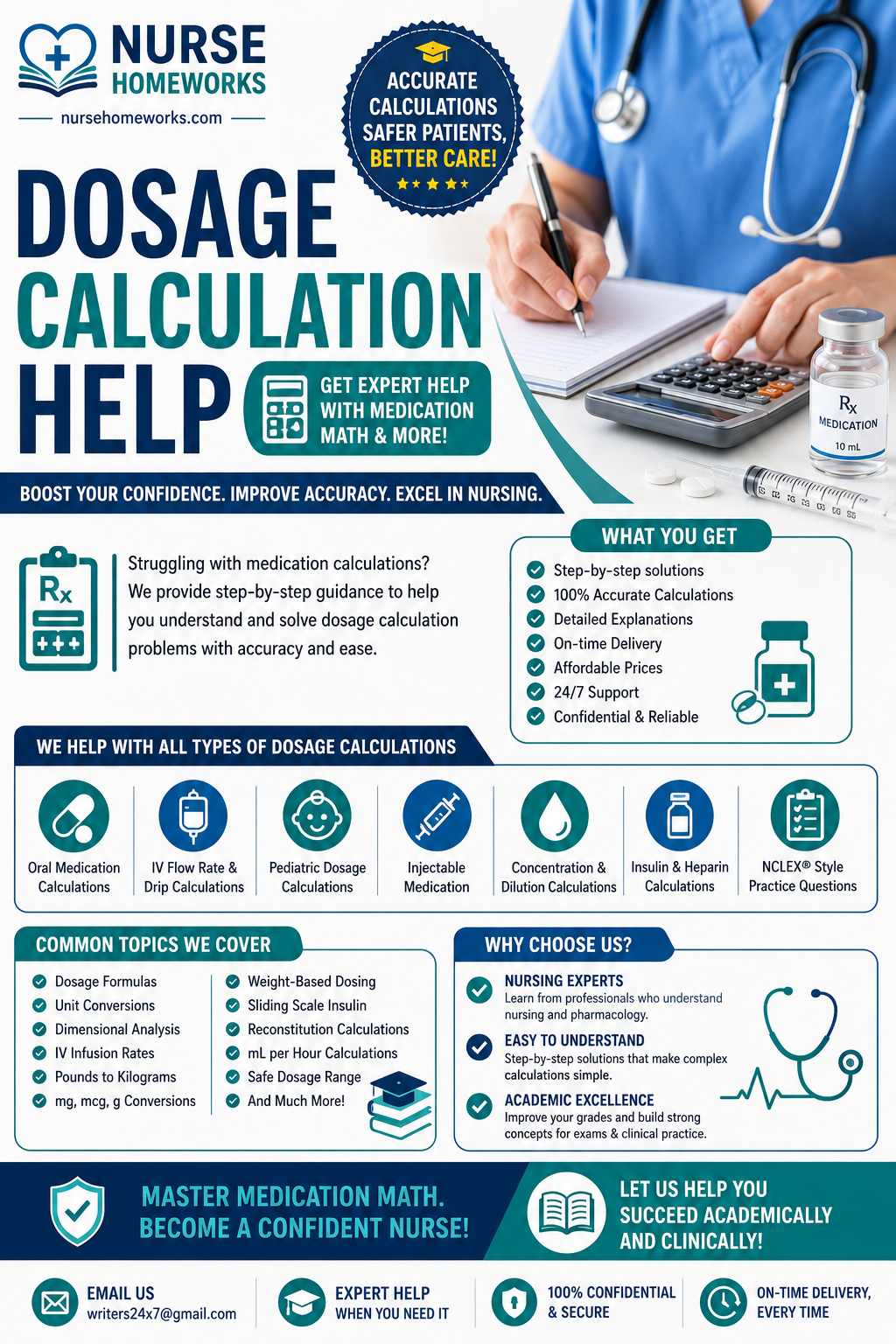
Medication math is one of the most important skills in nursing school and clinical practice. Nursing students are expected to calculate medication dosages accurately to ensure patient safety and effective treatment. However, many students struggle with formulas, conversions, IV flow rates, and dimensional analysis. That is why many students search for reliable Dosage Calculation Help to improve understanding, complete assignments, and prepare for exams.
At nursehomeworks.com, nursing students can receive academic support for dosage calculations, medication math assignments, pharmacology homework, and nursing exam preparation. Whether you are struggling with oral medication calculations, pediatric dosages, IV drip rates, or insulin conversions, professional guidance can help you gain confidence and improve accuracy.
Get Your Custom Essay Written From Scratch Dosage Calculation Help – Complete Guide for Nursing Students
 Get Answer Over WhatsApp
 Order Paper Now
Just from $13/Page
Why Dosage Calculation Skills Matter in Nursing
Dosage calculations are critical in nursing because incorrect medication administration can harm patients. Nurses must calculate medications precisely to avoid overdosing, underdosing, and medication errors.
Nursing students must learn how to:
- Calculate oral medications
- Measure IV infusion rates
- Convert measurement units
- Determine pediatric dosages
- Calculate medication concentrations
- Administer insulin safely
- Understand dimensional analysis
- Solve drip factor equations
Medication calculation skills are tested throughout nursing school and on licensing examinations such as NCLEX.
Common Challenges Nursing Students Face with Dosage Calculations
Many nursing students find medication math difficult because it combines mathematics, pharmacology, and clinical reasoning.
Common struggles include:
- Confusion with formulas
- Unit conversion errors
- Difficulty understanding dimensional analysis
- Anxiety during timed exams
- Problems calculating IV flow rates
- Pediatric dosage calculations
- Understanding medication labels
- Fraction and decimal mistakes
Professional dosage calculation assistance helps students simplify these concepts and improve confidence.
What Is Dosage Calculation Help?
Dosage Calculation Help refers to academic support provided to nursing students who need assistance with medication math and pharmacology calculations.
Students may receive help with:
- Homework assignments
- Practice questions
- Medication math tutoring
- IV calculations
- Pharmacology coursework
- NCLEX preparation
- Pediatric dosage calculations
- Drug dosage formulas
At nursehomeworks.com, nursing students can access affordable support tailored specifically for medication calculation coursework.
Understanding Basic Dosage Calculation Formulas
Nursing students must understand common dosage formulas used in clinical settings.
One of the most widely used formulas is:
Dose to Administer=Desired DoseAvailable Dose×Quantity\text{Dose to Administer} = \frac{\text{Desired Dose}}{\text{Available Dose}} \times \text{Quantity}
This formula helps nurses determine how much medication to administer based on physician orders and available medication strength.
Example
If a doctor orders 500 mg of medication and the available tablet contains 250 mg, the calculation becomes:
500 mg250 mg×1=2 tablets\frac{500\text{ mg}}{250\text{ mg}} \times 1 = 2\text{ tablets}
The nurse would administer two tablets.
Importance of Unit Conversions in Dosage Calculations
Unit conversions are essential in nursing calculations. Students must convert between:
- Milligrams and grams
- Milliliters and liters
- Pounds and kilograms
- Micrograms and milligrams
Common Conversion Example
1 g=1000 mg1\text{ g} = 1000\text{ mg}
A nurse must accurately convert measurements before administering medication.
IV Flow Rate Calculations
Intravenous therapy requires accurate calculations to ensure patients receive medications safely.
Students often struggle with:
- Drip rate calculations
- Infusion time calculations
- mL/hour calculations
- Drop factor formulas
A common IV flow formula is:
Flow Rate=Volume×Drop FactorTime\text{Flow Rate} = \frac{\text{Volume} \times \text{Drop Factor}}{\text{Time}}
This formula determines the number of drops per minute needed for IV administration.
Pediatric Dosage Calculation Help
Pediatric calculations are especially important because children require weight-based dosing.
Incorrect pediatric dosages can be dangerous because children are more sensitive to medication errors.
Weight Conversion Formula
Weight in kg=Weight in pounds2.2\text{Weight in kg} = \frac{\text{Weight in pounds}}{2.2}
Students must first convert weight into kilograms before calculating medication doses.
Dimensional Analysis in Nursing Math
Dimensional analysis is a step-by-step method used to solve medication calculations while ensuring units cancel correctly.
Many nursing schools prefer dimensional analysis because it reduces errors and improves calculation accuracy.
Students often seek help understanding:
- Unit cancellation
- Formula setup
- Multi-step calculations
- Conversion factors
Academic guidance can make dimensional analysis easier to understand.
Dosage Calculation Help for Pharmacology Courses
Pharmacology is one of the most difficult nursing subjects because students must memorize medications while solving dosage problems.
Common pharmacology assignments include:
- Drug dosage calculations
- IV medication math
- Safe dosage ranges
- Medication conversions
- Drug concentration calculations
Professional support helps students organize formulas and understand medication safety principles.
NCLEX Dosage Calculation Preparation
Medication math questions frequently appear on NCLEX exams. Nursing students must demonstrate safe medication administration skills before becoming licensed nurses.
NCLEX dosage preparation may include:
- Practice calculations
- IV infusion questions
- Medication safety principles
- Pediatric calculations
- Insulin calculations
Students who practice regularly improve confidence and exam readiness.
Why Students Need Dosage Calculation Help
Fear of Medication Errors
Students worry about harming patients through incorrect calculations.
Difficult Math Concepts
Many students have weak math backgrounds and struggle with formulas.
Test Anxiety
Medication math exams are often timed and stressful.
Complex Clinical Calculations
Advanced nursing programs include difficult IV and critical care calculations.
Fast-Paced Nursing Programs
Students may not have enough time to master medication math independently.
Common Dosage Calculation Topics in Nursing School
Students often seek help with the following topics:
- Oral medication dosages
- Injectable medication calculations
- IV drip rates
- Flow rate calculations
- Pediatric dosages
- Critical care medication math
- Insulin administration
- Heparin calculations
- Reconstitution calculations
- Weight-based dosing
Dosage Calculation Help for Online Nursing Students
Online nursing programs require students to complete dosage calculations independently without classroom support.
Challenges include:
- Limited instructor interaction
- Self-paced learning
- Complex online quizzes
- Tight deadlines
Affordable online academic support helps students stay organized and improve understanding.
Importance of Accuracy in Medication Calculations
Medication safety is one of the most important responsibilities in nursing.
Even small errors can cause:
- Patient injury
- Allergic reactions
- Treatment failure
- Medication toxicity
That is why nursing schools place strong emphasis on dosage calculations and medication safety training.
Dosage Calculation Help for Clinical Practice
Clinical placements require nursing students to calculate medications under supervision.
Students may need help understanding:
- Medication labels
- Syringe measurements
- IV pumps
- Dosage verification
- Safe administration procedures
Academic support helps students prepare for real-world nursing responsibilities.
Benefits of Professional Dosage Calculation Help
Improved Confidence
Students become more comfortable solving medication math problems.
Better Grades
Practice and guidance improve academic performance.
Reduced Anxiety
Understanding formulas helps students feel less stressed during exams.
Stronger Clinical Skills
Medication math knowledge improves clinical competence.
Better NCLEX Preparation
Consistent practice strengthens licensing exam readiness.
Dosage Calculation Help for Different Nursing Programs
ADN Students
Associate degree students often focus on basic medication administration and oral dosage calculations.
BSN Students
Bachelor’s students encounter advanced pharmacology and evidence-based medication management.
MSN Students
Graduate nursing students study advanced practice medication calculations and prescribing concepts.
LPN Students
Practical nursing programs emphasize safe medication administration and dosage accuracy.
Common Medication Calculation Mistakes
Students should avoid:
- Decimal point errors
- Incorrect unit conversions
- Formula setup mistakes
- Misreading medication labels
- Forgetting to convert pounds to kilograms
Professional guidance helps students identify and correct these mistakes.
Strategies for Improving Dosage Calculation Skills
Practice Daily
Regular practice improves speed and accuracy.
Memorize Conversion Rules
Understanding conversions is essential for medication safety.
Double-Check Calculations
Always verify answers before administration.
Understand Formulas
Do not memorize blindly; understand the purpose of each formula.
Use Dimensional Analysis
This method reduces calculation mistakes significantly.
Dosage Calculation Help for Critical Care Nursing
Critical care settings require advanced medication calculations involving:
- IV titration
- Cardiac medications
- Vasopressors
- Continuous infusions
- Emergency drug dosages
Students often need additional practice to master these calculations safely.
Affordable Dosage Calculation Homework Assistance
Many students search for affordable nursing academic support because nursing school expenses are already high.
Affordable dosage calculation assistance helps students access:
- Practice questions
- Homework support
- Formula explanations
- Exam preparation
- Medication math tutoring
At nursehomeworks.com, students can receive affordable support tailored specifically for nursing coursework.
Dosage Calculation Help for ESL Nursing Students
English as a Second Language nursing students may struggle with medical terminology and word problems.
Support may help with:
- Understanding instructions
- Interpreting medication orders
- Solving word-based calculations
- Improving nursing terminology comprehension
Preparing for Dosage Calculation Exams
To succeed in medication math exams, students should:
- Practice regularly
- Study conversion charts
- Review pharmacology notes
- Solve NCLEX-style questions
- Learn from mistakes
- Focus on patient safety principles
Consistent preparation improves both speed and accuracy.
Why Choose nursehomeworks.com for Dosage Calculation Help?
Students trust the platform because it focuses on nursing education support.
Services include:
- Medication math assistance
- Nursing homework support
- Pharmacology assignment help
- NCLEX preparation
- IV calculation guidance
- Pediatric dosage assistance
- APA formatting support
The goal is to help nursing students improve confidence and academic performance while understanding safe medication practices.
Final Thoughts on Dosage Calculation Help
Medication calculations are a critical part of nursing education and patient safety. Although dosage calculations can feel overwhelming at first, consistent practice and proper guidance can make them easier to understand.
Whether you need help with:
- IV flow rates
- Pediatric calculations
- Drug dosage formulas
- Unit conversions
- Pharmacology homework
- Medication math exams
- NCLEX preparation
nursehomeworks.com offers affordable and professional academic support for nursing students worldwide.
With the right guidance, nursing students can build confidence, improve calculation accuracy, reduce exam anxiety, and prepare for safe clinical practice.
Needs help with nursing assignment?
We are available 24x7 to deliver the best services and assignment ready within 3-4 hours? Order a custom-written, plagiarism-free paper
Get Answer Over WhatsApp
Order Paper Now